
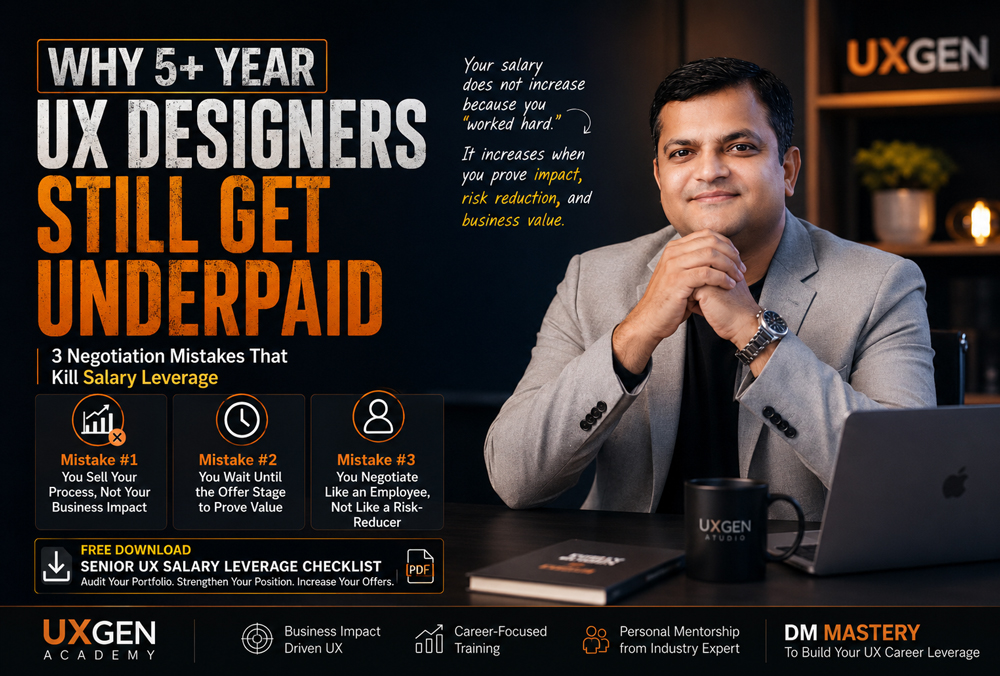
Why Senior UX Designers Stay Underpaid
Most 5+ year UX designers do not lose salary leverage because they lack raw design talent. They lose leverage because:
- They present tactical design outputs (wireframes, user journeys) instead of strategic business outcomes (revenue, retention, risk mitigation).
- They fail to connect UX work with executive priorities like business risk, customer trust, and decision clarity.
- They wait to negotiate until the offer stage, completely missing the positioning window.
Your salary does not increase because you “worked hard” or pushed more pixels. It increases when you prove impact, risk reduction, and business value.
A lot of senior designers are aggressively searching for their next ux job, hoping for a better role, more authority, or a massive salary jump. But even after 5+ years in the industry, many still enter executive interviews sounding like execution-level designers.
They talk about screens. They explain their design process step-by-step. They show high-fidelity wireframes. They proudly state that they “improved the user experience.”
Then they sit back, wait for the offer, and wonder why the compensation package is relentlessly average.
Here is the uncomfortable truth: Your case studies lack outcomes and accountability. And when your work does not show measurable business value, your salary negotiation becomes weak before it even starts. This is exactly why many designers search for terms like “experienced ux no job offer” even after spending years in the trenches. The problem is not your skill or your command of Figma. The problem is how you position that skill to the people writing the checks.
At the senior and lead level, executive hiring teams do not pay premium salaries for design activity. They pay for judgment, ownership, business clarity, and the mitigation of risk. They want an executive-grade UX partner.
Let’s break down the three fundamental negotiation mistakes that keep experienced UX/UI designers underpaid—and how to rewire your approach to command the compensation you actually deserve.
Mistake 1: You Sell Your Process, Not Your Business Profitability
When you sit down to negotiate a salary jump, the hiring manager, CTO, or executive team is doing silent math. They are actively calculating the Return on Investment (ROI) of hiring you versus a cheaper junior designer.
Most senior UX portfolios still follow a junior, bootcamp-style pattern: Problem statement, research, persona, user journey, wireframes, and final UI screens.
This structure is not technically wrong, but it is deeply incomplete for a senior professional. At 5+ years, the hiring manager is no longer asking, “Can this person design?”
They are asking:
- “Can this person make better product decisions that save engineering hours?”
- “Can this person protect our conversion rates or build customer trust?”
- “Can this person handle ambiguity without waiting for a product manager’s instructions?”
This is where the vast majority of designers fail. They show what they created, but not what changed for the business because of their work. Executives don’t care about “making things look pretty.” They care about diagnosing complex friction points that bleed cash. They care about metrics like Revenue Per Visitor (RPV), Customer Acquisition Cost (CAC), and Net Revenue Retention (NRR).
The Psychological Gap in Your Pitch
You want to talk about how you applied the Zeigarnik Effect to a progress bar, or how you used Fitts’s Law to optimize button placement. That is great, but stakeholders do not care about the psychological laws themselves; they care about the financial result of those laws.
If you apply Jakob’s Law to ensure a product aligns with existing mental models, you aren’t just “making it intuitive”—you are drastically reducing the cognitive load required to adopt the software, which directly lowers the Customer Acquisition Cost (CAC) and speeds up the sales cycle.
Weak Case Study Language (Low Leverage):“I redesigned the SaaS onboarding flow to make it more user-friendly and aesthetically pleasing, resulting in a cleaner user journey.” This sounds clean, but it generates absolutely zero leverage. It is a cost-center statement.
Strong Case Study Language (High Leverage):“The enterprise onboarding flow had a high drop-off at the account setup stage because users were unclear about required business information. I simplified the input structure, applying progressive disclosure to reduce decision hesitation. This redesign improved activation quality, decreased the time-to-value, and reduced support dependency by 20% during the first 30 days of onboarding.”
Now, you are not just designing screens. You are reducing friction in the revenue path. You are protecting the company’s bottom line. Revenue drivers command premium salaries.
Mistake 2: You Wait Until the Offer Stage to Prove Your Value
Many UX designers treat salary negotiation as the absolute last step in the hiring process. They think, “I will wow them with my portfolio, pass the whiteboard challenge, and then we will talk money.”
That is a massive, costly mistake. Salary leverage starts from the very first recruiter call.
By the time a company hands you an offer letter, they have already placed you in a mental pricing bracket. That bracket was entirely shaped by your resume positioning, your portfolio language, your initial interview examples, and your confidence in explaining product trade-offs.
If you sound tactical and operational in the first call, you cannot suddenly demand a strategic, executive-level salary at the final discussion. The cognitive dissonance is too high for the hiring manager to accept.
Mastering the Initial Positioning
The way you answer the very first question dictates your final salary.
The Wrong Way to Position Yourself:Recruiter: “Tell me about your experience.” Designer: “I have worked on mobile apps, websites, design systems, prototypes, and user research for over 5 years. I specialize in end-to-end design.” (Result: You sound like a list of tasks. Tasks can be outsourced cheaply. You are placed in the mid-level pricing bracket.)
The Executive-Grade Way:Designer: “I work on complex UX problems where unclear journeys or decision friction negatively affect business conversion and user trust. In my recent enterprise work, I focused on simplifying complex SaaS flows. My goal is always to ensure users can complete critical tasks with fewer errors, ultimately protecting the platform’s Net Revenue Retention and reducing the load on the customer success team.”
This is how salary leverage begins. Not at the HR negotiation table, but at the positioning stage. You immediately separate yourself from pixel-pushers and align yourself with the business leaders.
Mistake 3: You Negotiate Like an Employee, Not a Risk-Reducer
There is a growing, frustrating trend in the industry. You have the years on your resume, you have the hard skills, but after the final interview round, you either get ghosted or lowballed.
Most designers negotiate based on entitlement: “I have 5 years of experience, so I expect X salary.”
That is weak leverage. A business does not care about your tenure; they care about their bottom line. Good design is invisible; bad design is an operational hazard. Every time a development team builds the wrong feature based on poor UX assumptions, the company burns hundreds of thousands of dollars in engineering salaries and lost market time.
The Teardown Strategy: Creating Unfair Leverage
Never go into a final interview or negotiation empty-handed. If you position yourself as a generic “UX/UI Designer” who executes tasks, you can be replaced by someone cheaper. You must bring unique leverage.
Before the final interview, conduct a rigorous heuristic evaluation or rapid usability teardown of their core product.
Come to the table and say:“I noticed a significant conversion bottleneck in step three of your platform’s checkout flow. Based on standard enterprise drop-off rates and Gestalt Principles of proximity, that friction is likely costing you around $50k in lost recurring revenue monthly due to user abandonment. Here is the strategic framework I would use to diagnose and fix it within my first 30 days.”
A premier negotiation does not sound like begging for a raise. It sounds like this:“My salary expectation is based on the scope of problems I can solve. I have a track record of reducing user friction in critical workflows and helping teams make better UX decisions before development costs increase. My goal is to ensure we don’t build the wrong thing.”
You are not asking for more money just because you want it. You are showing why your presence serves as an insurance policy against expensive product mistakes. Business pays a premium when risk goes down.
The Executive UX Scorecard: Audit Your Leverage
If you want to command a premier salary, audit your current approach against this simple scorecard. Give yourself one point for every “Executive” trait you currently possess.
| Evaluation Area | The Average UX Designer (Low Leverage) | The Executive UX Partner (High Leverage) |
|---|---|---|
| Primary Focus | Wireframes, color palettes, and empathy maps. | CAC, NRR, conversion rates, and business impact. |
| Problem Solving | Fixes “bad usability” or “outdated UI.” | Fixes revenue leaks, system friction, and trust gaps. |
| Psychological Application | Uses vague terms like “intuitive” and “clean.” | Applies Gestalt, Jakob’s Law, and Fitts’s Law to drive specific behaviors. |
| Interview Style | Explains the step-by-step design process. | Discusses trade-offs, constraints, engineering costs, and ROI. |
| Negotiation Ask | “I have 5 years of experience, so I deserve X.” | “My strategy reduces product risk and rework, making X a high-ROI investment.” |
If you are leaning toward the “Average” column, it perfectly explains the “experienced ux no job offer” phenomenon. The market cannot see your value clearly because you are speaking the wrong language.
Building True Career Leverage with UXGen Academy
Knowing these mistakes is step one. Rewiring how you approach your entire career, your portfolio, and your executive communication is step two. This is exactly why we built the UXGen Mastery program.
At UXGen Academy, we do not teach UX as digital decoration. We teach it as a rigorous, business-critical function. Our curriculum is fiercely career and job-oriented, designed specifically for professionals looking for a faster switch, a better role, and a massive salary jump. We don’t do generic “UX tips.” We build architects.
To ensure our learners get the highest caliber of training, we brought in Mentor Manoj, a UX researcher and hiring geek with over 25+ years in the field. Manoj has sat on the other side of the executive negotiation table for decades. He deploys his total experience to show learners exactly where portfolios fail, what hiring managers are secretly scoring you on, and how to command the room.
Through our AI Driven UX Mastery roadmap, we provide practical, up-to-date knowledge that actually matters in today’s market. We show you how to intelligently leverage AI to conduct faster heuristic evaluations, gather deeper analytics, and build scalable, high-converting enterprise solutions without getting bogged down in manual tasks. We teach you how to think like a CTO, speak like a CEO, and execute like a master architect.
We bridge the gap between design theory and business reality. This is not about adding more certificates to your LinkedIn profile. It is about building the kind of deep UX maturity that makes hiring teams think, “This person can handle real business problems. We need to secure them before our competitors do.”
Take the Next Step: Audit Your Portfolio
Before you apply for your next ux job, before you update your resume, and before you step into your next interview, you need to know exactly where your narrative is weak. You need to stop leaving money on the table.
Download: The Senior UX Case Study Audit Checklist (PDF)
Use this rigorous checklist to identify whether your portfolio, interview answers, and salary positioning are helping or killing your leverage. It includes a 15-point salary leverage scorecard, a senior outcome template, and the business impact vocabulary you need to master.
Stop talking about process. Start proving your business value.
Frequently Asked Questions (FAQs)
- Why do 5+ year UX designers still get underpaid in today’s market?
Many 5+ year UX designers stay underpaid because they present themselves as execution-level resources instead of strategic business problem-solvers. They show screens, Figma files, and processes but fail to show outcomes, accountability, and how their work directly impacts the company’s bottom line (revenue, retention, acquisition).
- Why am I an experienced UX designer with no job offer after multiple final rounds?
If you are constantly searching “experienced ux no job offer,” the issue is almost certainly weak positioning rather than a lack of raw design skill. Hiring teams need to see decision quality, ownership, and business relevance. If your portfolio only shows what you designed but not why it mattered financially, you become a high-cost risk rather than a high-value asset.
- How can I get a better UX job with 5+ years of experience?
To secure a premium ux job, you must rewrite your resume and portfolio around business problems. Focus heavily on UX decisions, measurable outcomes, stakeholder alignment, and product risk reduction. Senior hiring panels look for judgment, trade-off clarity, and strategic thinking, not just design activity.
- What must a senior UX case study include to build real salary leverage?
A senior UX case study must move beyond the standard “research-to-wireframe” pipeline. It should explicitly state the business problem, the user friction causing revenue/trust leaks, your strategic design decision, the constraints and trade-offs you navigated, and the measurable outcome or learning. It must answer the ultimate executive question: What changed for the business because of your work?
- How do I prove business value in an interview if I didn’t have access to strict analytics in my last role?
If you lack hard data (like exact RPV or CAC) from past roles, use responsible framing based on standard industry benchmarks. Focus heavily on how your design decisions reduced friction, mitigated engineering rework (which saves massive development time and money), or lowered the burden on customer support. You can always frame your case study around the intended business outcomes, the psychological laws applied to reduce cognitive load, and the specific risk you reduced for the organization.


