
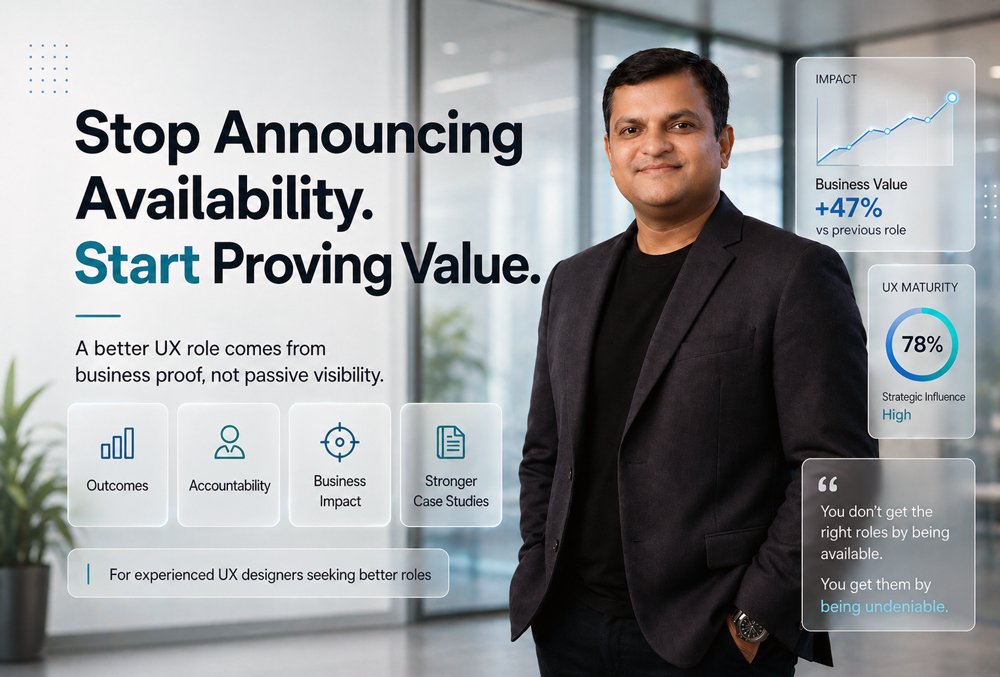
If you want a better ux job in 2026, posting “open to work” is not enough. Hiring teams are not only checking whether you are available; they are checking whether your thinking can reduce risk, improve conversion, support retention, and create business clarity. Most experienced designers are not stuck because they are invisible. They are stuck because their market signal is weak.
And here is the uncomfortable truth: Your case studies lack outcomes and accountability. That is why your experience is not converting into interviews. That is why your portfolio looks “senior” visually, but not strategically. That is why the search query in your head sounds like this: experienced ux no job offer. The market has changed. The era of hiring designers simply to make software look pretty is over. Your positioning must change too.
Why Experienced UX Designers Are Struggling to Switch Roles
A lot of UX/UI designers with 5+ years of experience are doing exactly what they were told to do five years ago. They update their LinkedIn profiles. They slap on the “open to work” badge. They redesign the visual layout of their portfolio. They apply to 50 or 100 jobs on various job boards. And then, they wait.
Still, nothing strong happens. The interviews do not come, or if they do, the salary offers are insultingly low.
The problem is rarely your fundamental design talent. The problem is your market signal.
In 2026, the UX job market is not simply about “more designers versus fewer jobs.” It is highly specialized and fiercely protective of budgets. Employers are valuing product thinking, AI literacy, strategic judgment, and the undeniable ability to connect UX decisions directly to business outcomes. When a company hires a senior UX professional, they are making a high-stakes business investment.
So, when your portfolio only says:
- “I redesigned the dashboard.”
- “I improved the user flow.”
- “I created high-fidelity wireframes and prototypes.”
- “I followed the double-diamond design thinking process.”
It simply does not create enough executive confidence. Hiring managers, VP of Product, and startup founders are asking a much sharper question now: Can this person improve my business metrics, or will they only polish my screens? That is the real filter you are failing to pass.
Availability Is Not Positioning
Many designers operate under the assumption that visibility means opportunity. But visibility without proof of value creates incredibly weak demand.
Posting “I am available for UX roles and actively interviewing” tells the market exactly one thing: you need a job.
It does not tell a CEO what critical business problem you can solve. It does not show what kind of product complexity you can handle. It does not reveal how you think under severe engineering constraints, how you measure success, how you influence stubborn stakeholders, or why you are worth a premium salary jump.
This is why announcing availability rarely creates premium opportunities. It may create sympathy. It may create a few likes from your peers. It may create generic comments. But premium hiring is not based on sympathy. It is based entirely on trust.
LinkedIn itself has explained that feed ranking uses signals like relevance, engagement, and dwell time. The algorithm monitors whether people actually spend time reading your content, not just whether they passively click a thumbs-up. Therefore, your profile and your content must do more than just exist on the platform. They must make people pause. They must show deep, strategic thinking. They must make a hiring manager stop scrolling and say, “This person truly understands product pressure and revenue generation.”
The Real Reason Behind “Experienced UX No Job Offer”
Let’s call it out directly. When someone quietly searches experienced ux no job offer late at night, the issue is usually a combination of weak proof points across their entire professional presence.
Here are a few pointers on the most common portfolio mistakes that instantly kill your chances at a senior role:
- Highly visual, but zero diagnostics: You show beautiful screens but fail to explain the initial business friction that required the redesign in the first place.
- Hidden constraints and trade-offs: You present the final solution as if it was obvious, completely ignoring the technical debt, tight timelines, or stakeholder disagreements you had to navigate.
- Missing metrics and baseline data: You highlight a “cleaner” user interface but fail to mention conversion lifts, reduced support tickets, or increased user retention.
- Dribbble-style showcases: You present complex enterprise workflows like art projects rather than rigorous risk-reduction strategies.
This is where the painful line comes in again: Your case studies lack outcomes and accountability. This is not because you are careless. It is because most UX designers were heavily trained by traditional bootcamps to present a process, not a business impact. But senior roles do not reward process alone. They reward judgment, strategy, and measurable outcomes.
The Value Proof Matrix: Weak vs. Strong Signals
To understand the shift from “process-heavy” to “outcome-led,” look at how you currently describe your work versus how an elite, executive-grade UX Architect describes it.
| Portfolio Element | Weak UX Job Signal (Process-Led) | Strong UX Job Signal (Outcome-Led) |
| Project Intro | “I was tasked to redesign the core e-commerce website.” | “The site had major trust gaps causing low consultation requests and high checkout drop-off.” |
| Research Phase | “I conducted 5 user interviews and sent out surveys.” | “Interviews revealed users hesitated primarily because they didn’t understand the pricing tiers.” |
| UX Decision | “I improved the layout, colors, and visual hierarchy.” | “I moved social proof and simplified pricing logic near the CTA to reduce cognitive load.” |
| Metrics & Impact | “Users reported having a better, cleaner experience.” | “Tracked form starts, CTA clicks, and reduced tier-1 customer support queries by 22%.” |
| Seniority Level | Junior to Mid-level tactical execution | Executive-level strategic risk reduction |
This is the non-negotiable shift. You must move your narrative from “look what I made” to “look what critical business problem I solved.”
The P.R.O.O.F. Framework for a Better UX Case Study
A strong UX case study should not only show what you designed; it must definitively prove why the decision mattered to the company’s bottom line. Use this exact P.R.O.O.F. framework to transform your portfolio from a visual gallery into a compelling business argument.
P – Problem with business cost
Never start your case study with “I was asked to redesign the app.” Start with the financial stakes. What was the exact cost of the UX problem? Was the current design causing a lower conversion rate? Was a confusing settings menu creating a high support load and draining Operational Expenditure (OPEX)? Was a slow onboarding flow killing user activation? Define the friction and its literal cost to the business.
R – Research and friction diagnosis
What concrete evidence did you gather to prove your hypothesis? Show the reasoning trail. Did you use analytics signals, heatmaps, support ticket logs, funnel drop-off rates, or stakeholder assumptions? You do not need perfect, granular data, but you absolutely must demonstrate diagnostic thinking.
O – Options and trade-offs
What design directions did you explicitly reject? This is incredibly important. Senior UX is not about choosing the prettiest layout. It is about choosing the lowest-risk solution under real-world constraints. Explain why you chose a standard, boring UI pattern over a highly innovative one because engineering lacked the bandwidth to build custom components. That shows extreme maturity.
O – Outcome and measurement
What changed after the design went live? This is where you establish accountability. Use specific numbers where possible. If exact revenue numbers are strictly under NDA, use observable indicators and percentages. Say things like, “After reducing the onboarding steps from 7 to 4, activation improved, support confusion dropped, and the product team had a cleaner journey to measure.” Show directional impact.
F – Future recommendation
What would you test next if you had another quarter to work on this? This shows deep product ownership. It tells the reviewer that you think far beyond the engineering handoff and actually care about the long-term health and iteration of the product.
Stop Looking Available. Start Looking Valuable.
Do not stop being visible on platforms like LinkedIn, but drastically upgrade your signal. Instead of begging your network for referrals or posting generic UX quotes, turn your feed into a demonstration of your expertise.
Instead of posting: “I am looking for UX opportunities. Please refer me.”
Try posting a UX Teardown. Pick a core flow in a well-known product or a targeted company you want to work for. Explain where users might hesitate, what specific business metric that hesitation negatively affects, what strategic trade-offs exist, and exactly how you would test a fix.
Or, post a Case Study Breakdown. Write a post titled “One UX mistake that silently kills SaaS onboarding activation.” Then briefly explain the problem, the friction, your solution, and the measurement.
This kind of content creates heavy dwell time and massive authority. It stops positioning you as a desperate candidate and instantly repositions you as a highly valuable consultant.
How UxGen Academy Builds Stronger Career Proof
At UxGen Academy, we know that training learners to simply create good-looking screens is a disservice. That is simply not enough to survive in the current market. Our entire focus is on rigorous, career-oriented UX mastery.
We teach you exactly how UX connects directly with revenue, how to diagnose deep systemic friction, and how to present your case studies with absolute accountability. We train you to speak in interviews like a product thinker, not just a pixel-pusher.
As the CTO and Co-founder, I ensure our curriculum is ruthlessly aligned with what the industry actually demands. And Mentor Manoj brings over 25+ years of heavyweight field experience as a researcher, UX architect, and hiring-focused mentor. His role is not to teach you basic Figma shortcuts; his goal is to deploy his total industry experience to show you exactly how executive hiring decisions are made behind closed doors.
The AI Driven UX Mastery program is meticulously designed for career switchers and experienced professionals who want faster transitions, better roles, and strong salary jumps. Because when you sit in a serious interview for a senior UX role, your software skill is not the primary thing being tested. Your business judgment is.
A better UX role does not come only from being seen. It comes from being trusted. If you are an experienced designer getting weak offers, do not ask “Why is nobody hiring me?” Ask, “Does my market signal prove that I can create business value?”
The market is not short of designers who can make screens. It is desperately short of designers who can diagnose friction, explain trade-offs, reduce risk, and connect UX directly with business outcomes. Fix your proof, and your positioning will immediately change.
Ready to Audit Your Signal?
Want to check if your portfolio is giving a senior signal or a weak signal? Use our comprehensive checklist to audit your case studies, map your design decisions to concrete business metrics, and start attracting the premium UX roles you actually deserve.
👉 Download the UX Role Value Proof Scorecard PDF here
FAQs
- Why am I not getting a UX job despite having 5+ years of experience?
Many experienced designers fail to get offers because their portfolios highlight their process but completely ignore business value. Hiring teams need undeniable proof that you can solve complex product problems, improve conversion rates, reduce expensive support loads, and make strategic design decisions under tight constraints. If you only show UI screens, you look like a junior executioner, not a senior strategist.
- What does “experienced ux no job offer” usually mean in reality?
It means your market signal is weak and untrustworthy. You may have worked on excellent, high-profile projects, but if your case studies lack outcomes, metrics, decision logic, and accountability, the market cannot accurately value your expertise. Executives cannot value what they cannot measure.
- What must a senior UX case study actually include to get noticed?
A senior-level case study must start with the initial business context (the financial cost of the problem). It must then flow into research evidence, explicitly state design trade-offs, show measurable outcomes, and provide future recommendations. It should document a rigorous reasoning trail, not just serve as a visual gallery of final screens.
- How can I make my UX portfolio more business-focused if I do not have exact data?
If numbers are under strict NDA or were simply unavailable to you at the time, focus heavily on directional impact and solid logic. Start every case study with the business problem, then connect your UX decisions to qualitative metrics like reduced friction, faster time-to-value, or improved user trust. Clearly explain how you would measure the success if you had full access to the analytics dashboard.
- Is posting “open to work” on LinkedIn enough to get a premium UX role?
Absolutely not. Announcing availability creates basic visibility, but it does not prove any value. To attract premium roles and higher salaries, you must share UX teardowns, product thinking insights, and detailed before-and-after decision breakdowns. You have to prove how you think. Proof beats presence every single time.


