
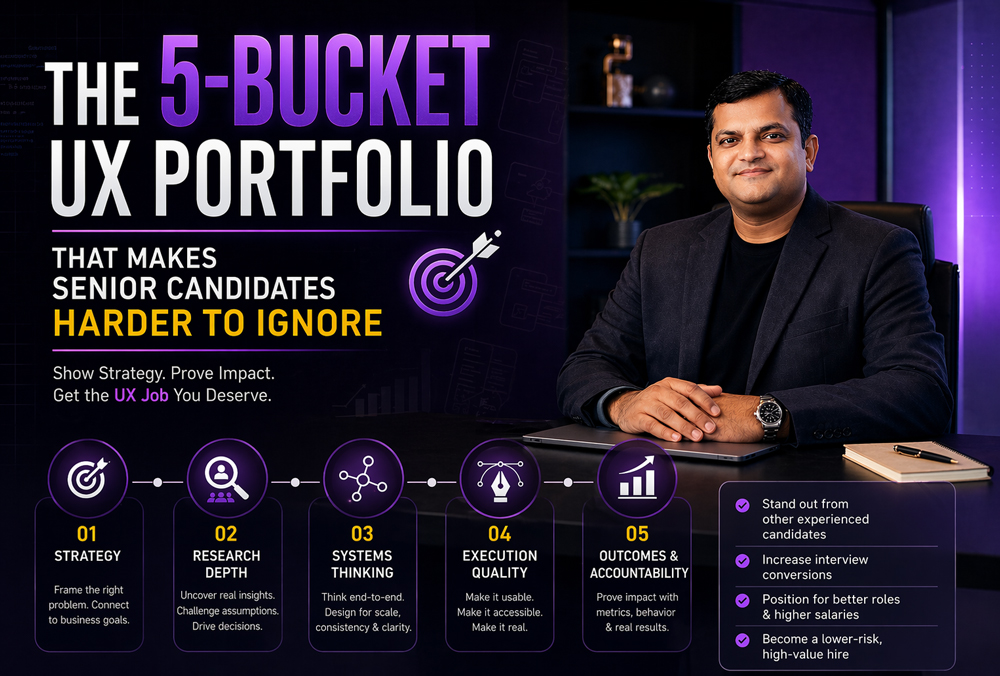
If you are struggling to land a better UX role, your problem is likely not a lack of experience, but a lack of portfolio signal. Senior candidates are ignored when their case studies show polished screens but fail to prove business value. The 5-Bucket UX Portfolio Framework fixes this by forcing you to demonstrate strategy, research depth, systems thinking, execution quality, and bottom-line outcomes. Hiring teams don’t buy screens; they buy risk mitigation and business impact.
In 2026, better roles are not going to designers with prettier screens. They are going to UX professionals whose portfolios prove strategy, research depth, systems thinking, execution quality, and business outcomes in one clear narrative.
I keep seeing the same pattern every single week. A designer comes to me with five or more years of experience. They have good companies on their resume, clean screens, and decent prototypes, yet they are getting ghosted. They are living the exact nightmare of being an experienced ux no job offer statistic.
They ask me what is going wrong, and I give them the direct, executive truth: Your case studies lack outcomes and accountability. Hiring teams, VPs of Product, and Founders do not review your portfolio like an art gallery. They review it as a risk document. They want proof that you can understand messy problems, work through ambiguity, make sound decisions, and move a business metric in the right direction.
If you want a premium ux job – the kind that comes with a better title and a significant salary jump – you must structure your work using the 5-Bucket UX Portfolio framework. Not five random projects, but five distinct layers of proof.
Bucket 1: Strategy and Business Context
Most portfolios start too late. They begin with the interface. Senior portfolios start before the screen even exists.
Show me the business problem and the friction. Why did the company invest money in this project? Was the issue user churn, a lagging onboarding process, rising support loads, or internal inefficiency?
A strong strategy section must explicitly state the business context, the underlying user problem, the constraints, and what was at stake if the company did nothing. When you frame the problem properly, your case study stops sounding like “I redesigned the dashboard” and starts sounding like “I reduced decision friction in a workflow that was slowing enterprise onboarding.” That is what a senior executive wants to hear.
Bucket 2: Diagnostic Rigor and Research Depth
Too many senior portfolios fake research. They mention “user interviews” in a single sentence and immediately move on to wireframes. That does not build trust.
Research depth means showing how an insight changed your direction. What assumption got disproved? What did stakeholders think the problem was, and what did your rigorous heuristic evaluation actually reveal?
You don’t need a hundred pages of data. Show a simple interview snapshot alongside a synthesis board. Highlight the top friction themes and clearly explain how this research directly shifted your design direction. This proves you are a strategic thinker, not just someone who is good at presenting polished Figma frames.
Bucket 3: Systems Thinking and Scalability
This is where senior candidates separate themselves from mid-level candidates. A mid-level portfolio shows pages; a senior portfolio shows logic.
Can you think across the entire user journey? Can you connect a front-end support issue to the backend information architecture? Systems thinking shows up when you document end-to-end flows, handle complex edge cases, build reusable interaction patterns, and highlight cross-functional dependencies.
Most real product problems are not screen problems; they are system problems. If your portfolio only shows the final UI, you are hiding one of the exact skills that enterprise and SaaS companies pay a premium for.
Bucket 4: Execution Quality and Trade-offs
Strategy without execution is just theory, and execution without strategy is mere decoration. You need both. This bucket is where you prove you can turn complex thinking into a scalable product.
Show your iterations, including the dead ends and the versions that failed. Explain how the interface became clearer, faster, or safer because of deliberate choices. Good execution proof lives in low-fidelity explorations, annotated wireframes, and clear collaboration notes detailing how you compromised with engineers to meet a sprint deadline.
The goal isn’t to dump every artifact you made, but to make your quality and pragmatic decision-making visible.
Bucket 5: Bottom-Line Outcomes and Accountability
This is the most ignored bucket, which brings us back to the core issue: Your case studies lack outcomes and accountability. Most portfolios end with “final designs” or a generic “what I learned” section. That is not enough for an executive. Tell me what moved. Did activation improve? Did task success go up? Did support tickets fall? Did internal teams move faster?
Even if you do not have perfect analytics access, you can still prove impact through before-and-after behavioral shifts, usability findings, support ticket reduction, or improved stakeholder confidence. This is the bucket that turns “I made a thing” into “I solved a costly business problem.”
How UXGen Academy Transforms Your Career Narrative
If you are an experienced professional realizing your portfolio is missing these buckets, do not rebuild everything from scratch. Rebuild the story layer.
At UXGen Academy, we view UX strictly as a career and business discipline. A lot of generic UX training teaches tools, trends, and surface-level process theater. That might help someone make a mock project, but it does not reliably help a serious professional win a high-paying, authoritative role.
This is where Mentor Manoj brings unparalleled value. As a researcher, CRO expert, and hiring geek with 25+ years in the field, he understands that portfolios fail because candidates do not know how to present depth and accountability. In our UXGen Mastery Premium Live Training, we deploy his total experience to help you figure out the best career solution.
We also integrate an AI Driven UX Mastery approach. AI can speed up production, but it cannot replace your judgment. We teach you how to become a sharper decision-maker who leverages AI for research synthesis, heuristic analysis, and system architecture without becoming generic.
📥 Take the Next Step: Your Portfolio Diagnostic
Don’t guess why you are getting filtered out. Use the exact framework I use to hire premium talent.
👉 Download the Senior UX Portfolio Accountability Checklist (PDF)
This guide includes the 5-bucket scoring sheet, metrics examples for UX outcomes, and a “before you apply” diagnostic to fix weak portfolio narratives. Want the deeper framework behind it? DM me the word “MASTERY” on LinkedIn.
Frequently Asked Questions (FAQs)
- What should a senior UX portfolio include?
A senior UX portfolio must move beyond visual design to show strategy, research depth, systems thinking, execution quality, and business outcomes. If it only shows polished UI screens, it is incomplete. It must demonstrate how you solve complex business problems.
- Why am I experienced in UX but still getting no job offer?
Usually, it is because your portfolio is not translating your experience into a clear hiring signal. The common gap is simple: your case studies lack outcomes and accountability. Hiring managers need visible proof of business impact and risk mitigation, not just years of experience.
- How many case studies do I need for a senior UX job?
You only need 2 to 3 deep, highly strategic case studies. Depth always beats volume. A tighter portfolio that clearly demonstrates the 5 buckets (Business context, Rigor, Systems, Trade-offs, Outcomes) is vastly more convincing than a large portfolio of shallow work.
- What metrics can I use if I do not have direct revenue access?
You can use proxy metrics that indicate business health. Focus on adoption rates, task success improvement, drop-off reduction, faster onboarding speed, reduction in customer support tickets, or internal operational efficiency.
- Should I include AI work in my UX portfolio?
Yes, but only if you frame it strategically. Do not present AI as a gimmick or a shortcut for visual design. Show how AI improved your research speed, synthesis quality, or decision support, while making your own human judgment and trade-off decisions highly visible.


