
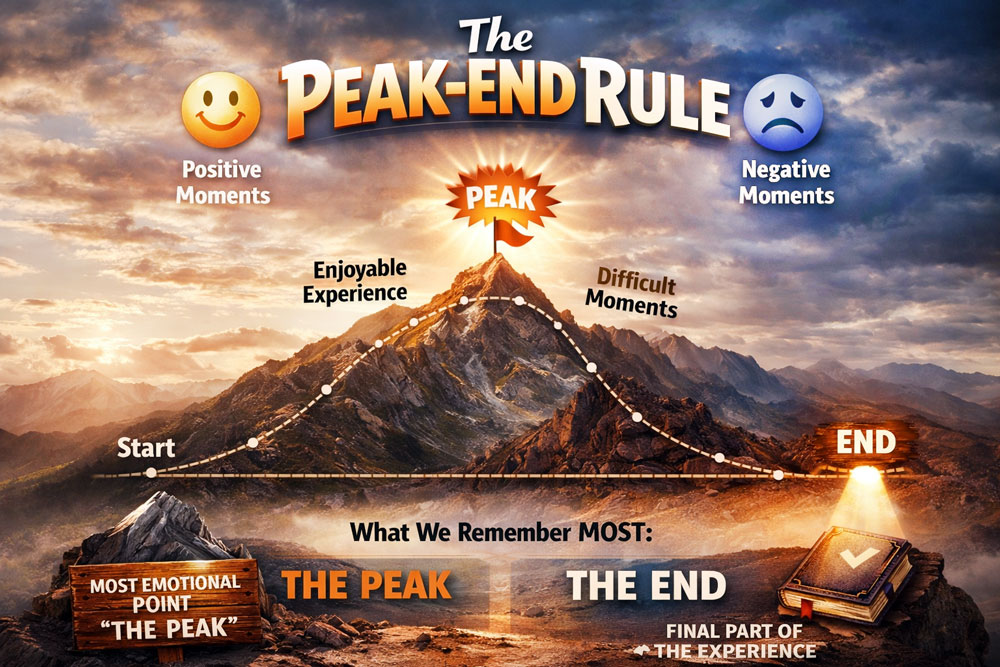
“People judge an experience largely based on how they felt at its peak and at its end, rather than based on the total sum or average of every moment of the experience.” – Daniel Kahneman
1. What is the Peak-End Rule?
The Peak-End Rule suggests that users don’t evaluate an experience based on an average of all moments. Instead, their memory is shaped almost entirely by two things: the most intense point of the experience (the “peak,” which can be positive or negative) and the final moments (the “end”). Creating a delightful peak and a satisfying conclusion ensures the overall product is remembered fondly, even if there were minor frictions along the way.
2. The Core Concept: Cognitive Bias in Memory
A Cognitive Bias in this context means users heavily weight specific emotional moments over the entire user journey.
- They remember the excitement of finally finding the exact item they were looking for (a positive peak).
- They remember the intense frustration of a broken checkout page losing their data (a negative peak).
- They remember a delightful and reassuring “Thank You” animation after completing a long form (the end).
When you design specifically for these emotional spikes and conclusions, you control the narrative of how your product is perceived and remembered after the user leaves.
3. Key Takeaways for UX Designers
- Identify and Elevate the Peaks: Figure out where the most emotional or critical moments occur in your user journey (like finding a match, completing a complex task, or unlocking a reward) and make them as delightful as possible.
- End on a High Note: Ensure the final step of the user journey (like a payment confirmation, a success message, or logging out) is reassuring, clear, and celebratory.
- Mitigate Negative Peaks: Pay close attention to severe points of friction (like error messages, dead ends, or long loading times). A severe negative peak can ruin the memory of an otherwise perfect experience.
4. Real-World Examples
- Email Marketing Apps (Mailchimp): Sending out a mass email campaign to thousands of people is a high-stress moment (a peak). When a user finally hits send, Mailchimp shows an animation of a monkey giving a high-five, releasing tension and ending on a positive, rewarding note.
- Language Learning Apps (Duolingo): After struggling through a tough lesson (peak effort), the app showers the user with celebratory animations, sound effects, and XP points. This rewarding end makes the user want to return, forgetting the difficulty of the questions.
- Ride-Sharing Apps (Uber): Waiting for a cab can be tedious, but watching the car icon arrive on the map provides a positive peak, and a smooth, cashless drop-off creates a frictionless positive end, masking the earlier wait time.
5. How to Handle the “Valleys” (Negative Peaks)
Because the Peak-End Rule is a psychological reality rather than a design rule you can “break,” the focus shifts to handling failures. System errors, out-of-stock items, or payment failures are inevitable. When a negative peak occurs, use helpful, humorous, or empathetic error messages to soften the blow. You can’t always prevent bad moments, but you can control how the system gracefully responds to prevent a minor issue from becoming the lasting memory.
Summary for Designers
“Design for the moments that matter most, not just the flow in between.” By respecting the Peak-End Rule, you ensure that even if a user’s journey has minor bumps, their lasting memory of your product remains overwhelmingly positive and satisfying.

