
The Real Reason You Aren’t Getting Selected
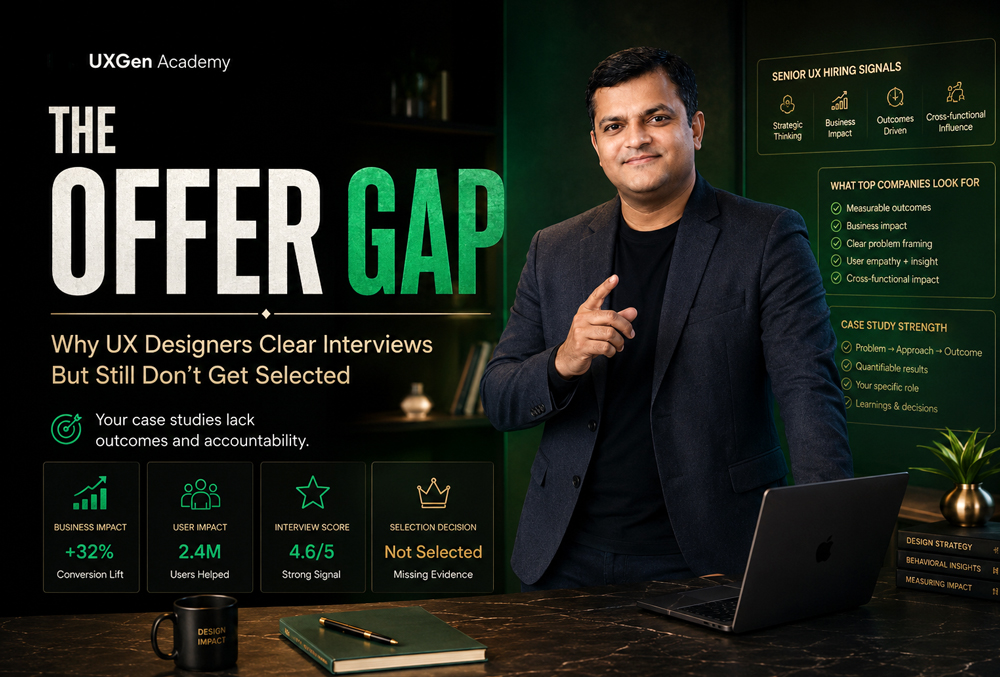
Many senior designers do not lose the UX job because they lack design talent. They lose it because the hiring team cannot clearly see their decision quality, business impact, and ownership. The core issue is simple: Your case studies lack outcomes and accountability. To bridge the offer gap, you must stop presenting screens and start proving how your UX decisions reduce business risk, lower support loads, and drive revenue. In senior hiring, silence makes you forgettable-strategic follow-up makes your decision quality visible again.
This is one of the most frustrating stages in a senior UX career.
You apply for a better, higher-paying role. You clear the initial screening round with the recruiter. You walk the panel through your portfolio presentation. The cross-functional team seems highly engaged. They nod, they smile, they ask good questions, and they tell you, “We’ll get back to you soon.”
Then, nothing.
Just silence.
No rejection email.
No constructive feedback.
And most importantly, no UX job offer.
I call this The Offer Gap. It is the massive canyon between being a “good interview” and becoming the “selected candidate.”
I am Vaibhav Mishra, CTO and Co-founder of UXGen Studio and UXGen Academy. In my career building high-converting solutions for enterprise and SaaS clients, I do not focus on making things look pretty. I focus on diagnosing complex friction points and engineering scalable solutions that directly impact business growth.
When we sit on the other side of the hiring table, I can tell you exactly what goes wrong when experienced designers-those with 5+ years under their belt-face this gap.
It is almost never about your Figma skills, your auto-layout proficiency, or your visual polish. It is about how clearly you prove what business problem you solved, what strategic decisions you influenced, and why you are a safe, profitable hire for a senior role.
If you find yourself repeatedly searching for answers to the “experienced ux no job offer” problem, you need to read this closely. Let’s break down exactly why you are getting stuck and how to completely restructure your approach to command the salary and role you deserve.
What Is the Offer Gap in UX Hiring?
The Offer Gap happens when a candidate looks highly capable during the interview but does not instill enough executive confidence to get the final selection.
This is incredibly common with UX/UI job switchers who have five to ten years of experience. You are not a beginner anymore. You know the tools, you know the design systems, and you know the jargon.
But you are also not communicating like an executive-grade UX professional.
You show projects, but you do not show business movement.
You show high-fidelity screens, but you hide your decision logic.
You explain your process in detail, but you avoid true accountability for the final result.
You sit in the interview and proudly state, “I improved the user experience.” But you do not explain what specific metric improved, how it was measured against baseline data, and why that improvement mattered to the company’s bottom line.
That is exactly where the offer gets lost. The hiring manager leaves the room and thinks: “Good designer. But I am not fully sure if this person can handle ambiguity, pushy stakeholders, strict metrics, and product pressure.”
That tiny sliver of doubt is all it takes to halt a $150k+ offer.
The Core Truth: Your Case Studies Lack Outcomes and Accountability
I will state this bluntly because it is the most important realization you can have in your career: Your case studies lack outcomes and accountability.
At the senior level, your portfolio is not an art gallery for Dribbble. It is a risk-reduction document for the business. The company is actively looking for reasons not to hire you. They are running a silent risk assessment.
They are asking themselves if you can diagnose complex friction, push back logically against product managers, and defend your decisions with hard evidence rather than personal preference.
This does not mean every single project must have perfect, multi-million dollar revenue numbers attached to it. Not every UX designer has access to live Google Analytics data after they leave a company. But every senior UX case study must show that you deeply understand cause and effect.
To make this crystal clear, here is a breakdown of how junior designers talk versus how executive-grade UX partners talk.
The Output vs. Outcome Reframing Table
If you want to command a premium salary, you must shift your language from design outputs (what you did) to business outcomes (what happened because of what you did).
| What You Usually Say (The Output) | What Executives Need to Hear (The Outcome) | Business Metric Impacted |
|---|---|---|
| “I redesigned the dashboard to make it more modern and intuitive.” | “I restructured the dashboard hierarchy to reduce decision friction for the operations team.” | Task completion time & Operational efficiency |
| “I improved the checkout UI and added a progress bar.” | “I identified trust and payment anxiety issues causing drop-offs and removed those friction points.” | Checkout conversion rate & Revenue Per Visitor (RPV) |
| “I built a UI component library in Figma.” | “I created reusable architectural components that eliminated rework and sped up developer handoff.” | Time-to-market & Engineering cost savings |
| “I conducted 5 user interviews to build empathy.” | “I translated user research findings into a workflow that resolved core user confusion at onboarding.” | Customer support ticket volume reduction |
| “I simplified the navigation menu.” | “I reorganized the architecture to surface high-value features, directly impacting our renewal rates.” | Net Revenue Retention (NRR) |
Notice the difference? The left side sounds like a task executor. The right side sounds like a business partner who understands how UX drives growth.
The Senior UX Interview Scorecard (What They Judge Silently)
Companies will never show you the internal rubric they use to score you. But having been in this industry, built businesses, and hired extensively, I can tell you exactly what is on it.
1. Problem Diagnosis
Can you identify the root friction behind the visible symptom?
Amateur Answer: “The UI was outdated and users didn’t like it.”
Executive Answer: “The UI looked outdated, but the deeper issue was severe cognitive overload. We were violating Miller’s Law by giving users 12 equal choices at the activation stage, causing decision paralysis and high drop-off rates.”
2. Business Translation
Can you connect your UX work to business outcomes? Good UX isn’t just empathy; it is a revenue driver. You need to tie your work to Customer Acquisition Cost (CAC), Net Revenue Retention (NRR), trust, support load reduction, or product adoption. If you only talk about user feelings and never mention business viability, you will fail the senior screen.
3. Stakeholder Handling
Senior UX is a highly political job. You must show how you handled product pressure, developer constraints, leadership expectations, and conflicting opinions without folding. Hiring panels want to know you can fight for the right user experience without destroying team morale or missing product launch deadlines.
4. Decision Quality and Psychological Grounding
Hiring managers want to know how you think. Why did you choose one direction over another? What were the trade-offs?
Are you basing decisions on trends, or are you utilizing psychological principles? A senior designer explains how they used the Zeigarnik Effect to design a progress tracker that keeps users engaged, or how they applied Fitts’s Law to optimize the placement of a primary call-to-action in a high-speed enterprise environment.
5. Ownership and Accountability
This is where many experienced designers fail the culture fit round. They say “we” too much. Teamwork is great, but unclear ownership is dangerous.
Do not say: “We redesigned the flow.”
Say: “The product team owned the timeline. My direct responsibility was to diagnose the onboarding friction, map the drop-offs, conduct the heuristic evaluation, and align the final UX solution with backend engineering constraints.” Be specific, precise, and accountable.
A Better UX Case Study Structure for Senior Roles
If you want your next case study to feel senior, scrap the generic “Double Diamond” template that bootcamp graduates use. That format is too slow and focuses too much on process over profit. Use this executive structure instead:
- Business Context & The Real Problem
Start with the business situation, not the design brief.
Example: “Our enterprise SaaS platform had strong top-of-funnel traffic but weak trial-to-paid conversion. The business was bleeding potential revenue because users did not understand the core value fast enough.”
- The UX Friction Diagnosis
Define the exact friction.
Example: “The main issue was not aesthetics. It was a poorly structured activation path. Users were facing too many complex configuration options before experiencing the product’s ‘Aha!’ moment.”
- My Role and Ownership
Be specific about what you controlled.
Example: “I acted as the Lead UX Architect. I owned the heuristic evaluation, the user journey re-mapping, and the final structural redesign of the onboarding decision path.”
- Key Findings and Strategic Insights
Show your diagnosis clearly.
Example: “Through analysis, I found users were skipping vital setup steps because CTA labels were ambiguous. This directly correlated with a spike in customer support queries during the first 48 hours of a trial.”
- Design Decisions and Trade-offs
Do not just show the beautiful final screen; explain the logic and what you had to sacrifice.
Example: “We moved the setup checklist into a modal above the dashboard to force guided progression. We traded a ‘free exploration’ model for a ‘guided linear’ model. It felt slightly more restrictive, but it was necessary to ensure successful setup.”
- The Business Outcome
Show directional or exact value.
Example: “This strategic shift created a cleaner activation path. It reduced initial dependency on customer support documentation by 30% and gave the product team a highly measurable onboarding structure to iterate on.”
5 Strategic Pointers to Bridge the Offer Gap
If you want to stop getting ghosted and start getting selected, you need a structural change in how you present your value. Here are five actionable pointers to execute before your next interview:
- Pointer 1: Audit for Accountability: Open your portfolio today. Look at your top three case studies. If they do not explicitly state what the initial business problem was and what changed after your work went live, pull them down and rewrite them immediately.
- Pointer 2: Elevate Your Vocabulary: Drop words like “delight,” “pretty,” or “make it pop.” Executives do not speak this language. Start using terms like “friction,” “conversion,” “retention,” “risk mitigation,” “cognitive load,” and “heuristic evaluation.” Speak the language of the boardroom.
- Pointer 3: Master the “Trade-Off” Answer: When a panel asks why you made a specific design choice, never just say “it’s better for the user.” Explain the trade-off. For example: “We sacrificed aesthetic minimalism to ensure the primary CTA was impossible to miss, optimizing for conversion rate over current visual trends.”
- Pointer 4: Stop Showing Every Iteration: A junior designer shows 50 messy wireframes to prove they did the work. A senior designer shows the one pivotal wireframe that solved the core problem, and explains the logic behind it. Curate your presentation for high-impact moments.
- Pointer 5: Prepare for the “Metrics Pushback”: If a company asks how you measure success and you say “user satisfaction surveys,” you will lose the room. Be prepared to discuss how you would partner with data analysts to track behavioral metrics like time-on-task, error rates, and feature adoption.
The Power of Strategic Follow-Up (Creating Dwell Time)
Here is a reality of human behavior: out of sight is out of mind.
Most UX candidates treat the follow-up as a polite chore. “Thank you for your time. I enjoyed speaking with you.” That is weak. It does not create selection confidence. In the algorithms of social media, “dwell time”-how long someone pauses to read your content-dictates your value. The same psychology applies to your hiring manager’s inbox. Your follow-up must create dwell time.
After the interview, candidates blend together. Your follow-up is a strategic tool to make your decision quality visible again. It must remind them what business risk you noticed, how you think beyond screens, and why you are the safest bet.
Here is a follow-up template you can use:
Subject: Thank you for the discussion / UX thoughts on [Product Area]
Hi [Name],
Thank you for the conversation today. I enjoyed understanding the product challenges more clearly, especially regarding the [specific feature/problem discussed].
One point that stood out to me was the need to improve the drop-off rate there. From my experience, this is rarely just an interface issue. It usually connects to user confidence, decision clarity, and ultimately impacts [mention a business metric like conversion or support load].
If I were approaching this problem, I would first diagnose where users are losing clarity using a quick heuristic audit, then map that friction to the product’s goals before executing interface decisions.
That is the analytical UX approach I would bring to the team. Thanks again for your time.
Best,
[Your Name]
This is not desperate. It is executive communication. It forces the hiring manager to pause, read, and realize you are a strategic partner who is already thinking about their business problems.
Close the Gap with AI-Driven UX Mastery
If you are reading this and realizing your portfolio, your vocabulary, and your interview strategy are stuck in the “process over profit” mindset, you are not alone. I see brilliant designers with incredible visual skills hit this wall every single day.
They want to switch jobs faster. They want a better role. They want a massive salary jump. But they do not know how to pivot their mindset from “designer” to “business partner.”
This is exactly why we built UXGen Academy.
We do not teach you how to draw rectangles in Figma. You already know how to do that. We teach you how to drive ROI and command a room.
Our AI Driven UX Mastery program is designed specifically for career switchers and experienced professionals who are tired of getting rejected in the final round. The curriculum is entirely job-oriented and career-focused.
To ensure this program is the most powerful asset in your career, our curriculum is spearheaded by Mentor Manoj, a veteran researcher, UX architect, and hiring geek with over 25 years of industry experience. Manoj has spent decades evaluating candidates, sitting on hiring panels, and defining what makes a UX professional truly indispensable to a business. In this course, he deploys his total experience, teaching you exactly how hiring managers think, how to use AI to conduct rigorous research faster, and how to position yourself as the ultimate solution to their business problems.
Inside the program, we focus heavily on:
- Strategic Diagnosis: Finding the real problem before you ever open a design tool.
- Business Impact Thinking: Connecting every pixel to a metric.
- Executive Interview Communication: Answering tough stakeholder questions with authority.
- AI-Assisted Workflows: Leveraging AI to speed up heuristic evaluations and user research mapping.
The goal is simple: We help you stop presenting yourself as a task executor and start positioning yourself as a premium UX professional who solves expensive friction. That is the shift that changes how your next interview feels.
Your Next Step: Audit Your Approach
You don’t need another generic list of “Top 10 UX UI Tips.” You need to ruthlessly audit how you are presenting your professional value.
If you are serious about securing a high-level UX job, you need to know exactly where your current presentation is failing.
Download The Senior UX Case Study Audit Checklist.
This is the exact framework you need to audit your case studies, fix your portfolio red flags, and ensure you are mapping your UX outputs to actual business ROI before you apply for your next senior role. Do not walk into another interview without checking your work against this standard.
Stop letting silence define your career progression. Claim your value.
DM me “MASTERY” on LinkedIn to start the conversation.
Frequently Asked Questions (FAQ)
- Why do UX designers clear interviews but not get job offers?
UX designers often clear initial screening rounds because their visual skills and basic portfolios look solid. However, they fail the final cross-functional rounds because they do not prove senior-level decision quality. Hiring teams reject candidates who cannot clearly articulate their business impact, demonstrate ownership of outcomes, and show the ability to handle pushback from product and engineering stakeholders.
- What does “experienced ux no job offer” usually mean in today’s market?
This scenario usually means a candidate has the required 5+ years of experience but is failing to position that experience correctly. In a competitive market, companies run lean teams. The problem is rarely a lack of design skill; it is usually unclear storytelling, weak case study outcomes, or a failure to connect UX metrics to hard business goals like revenue or retention.
- How can I improve my UX case study for senior roles?
Shift your focus entirely from design outputs to business outcomes. Start with the core business problem, define the specific UX friction you uncovered, clearly state your exact role in the project, explain the logic and trade-offs behind your design decisions, and tie the final outcome to metrics like conversion, task completion time, support load reduction, or user trust.
- Should I always follow up after a senior UX interview?
Yes, absolutely. However, do not send a generic thank-you note. A strategic follow-up is your last chance to show how you think and create “dwell time” with the hiring manager. Mention a specific business problem discussed during the interview and provide a brief, analytical outline of how you would diagnose and approach solving it.
- What is the biggest red flag hiring managers look for in senior UX portfolios?
The biggest red flag is a lack of accountability and an over-reliance on process over results. When a portfolio focuses entirely on empathy maps, personas, and wireframes but fails to show what actually happened after the design went live, it signals that the designer does not understand or care about the business impact of their work. They appear as a pixel-pusher, not a strategic partner.
- How does UXGen Academy help experienced designers overcome the offer gap?
UXGen Academy, specifically through our AI Driven UX Mastery program led by Mentor Manoj, helps learners build job-oriented UX thinking. We move beyond basic tool training and focus on practical curriculum, AI-assisted research workflows, portfolio restructuring, advanced interview preparation, and business-level UX communication. We teach you how to speak to executives and prove your ROI.


