
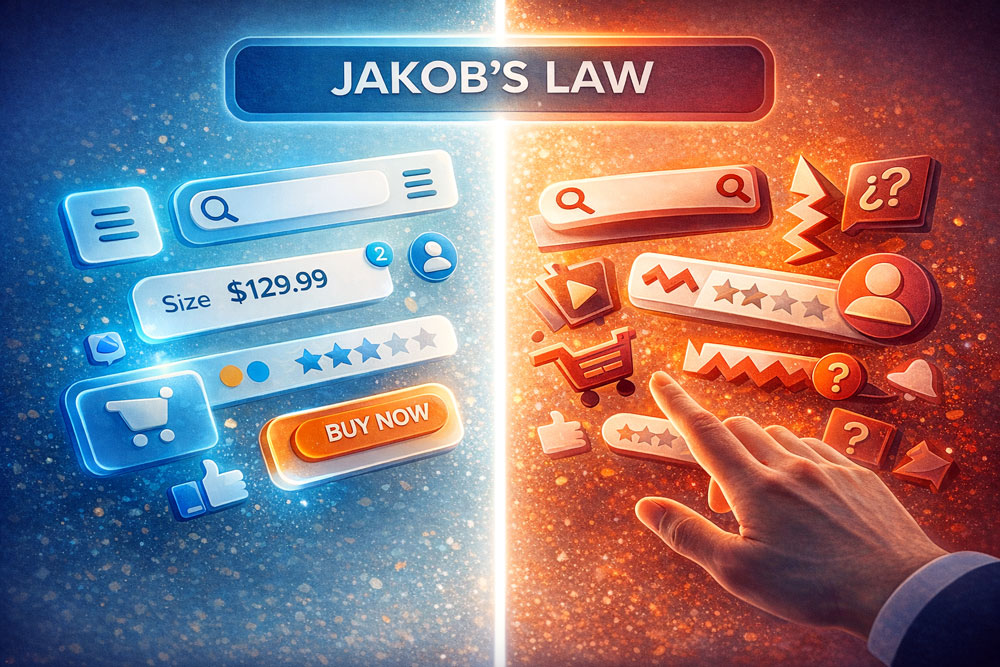
“Users spend most of their time on other sites. This means that users prefer your site to work the same way as all the other sites they already know.” — Jakob Nielsen
1. What is Jakob’s Law?
Jakob’s Law suggests that users carry over expectations from their experiences with popular platforms (like Google, Amazon, or Instagram) to your product. They don’t want to learn a new way of navigating every time they visit a new site. Familiarity equals comfort.
2. The Core Concept: Mental Models
A Mental Model is what a user believes they know about how a system works.
-
Users expect a search bar to be at the top.
-
They expect a logo to take them back to the ‘Home’ page.
-
They expect a “Cart” icon to be in the top-right corner.
When you follow these established patterns, you align with their mental models, making your interface feel “invisible” and easy to use.
3. Key Takeaways for UX Designers
-
Don’t Reinvent the Wheel: If a standard design pattern (like a hamburger menu or breadcrumbs) works perfectly, there is no need to create a “unique” version that confuses the user.
-
Lower Cognitive Load: By using familiar patterns, you allow users to focus on their goals (buying a product, reading an article) rather than learning how to use your interface.
-
Leverage Existing Knowledge: Use the user’s prior experience to your advantage. A design that feels familiar is a design that feels trustworthy.
4. Real-World Examples
-
E-commerce Layouts: Almost every successful e-commerce site follows a similar structure: Product image on the left, details on the right, and a prominent “Add to Cart” button.
-
Social Media Interactions: The “Heart” icon for liking or “Bell” icon for notifications is a universal language across almost all social apps.
-
Search Functionality: Users look for the magnifying glass icon. Placing it anywhere else creates unnecessary friction.
5. When Should You Break This Law?
Innovation is necessary, but it should be intentional. Only break Jakob’s Law if your new solution is significantly better (the “10x rule”) than the existing pattern. Even then, provide cues or onboarding to help the user adjust to the change.
Summary for Designers
“Focus on the value you provide, not the layout you inhabit.” By respecting Jakob’s Law, you ensure that the user’s journey is smooth, predictable, and free of frustration.

