
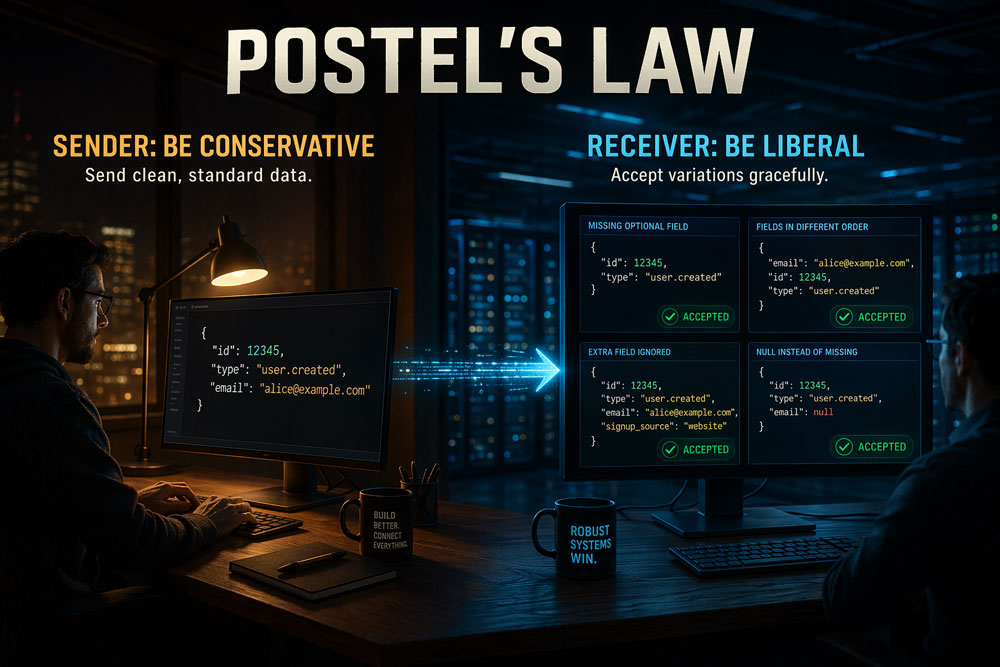
“Be conservative in what you do, be liberal in what you accept from others.” – Jon Postel
1. What is Postel’s Law?
Postel’s Law, also known as the Robustness Principle, is a foundational UX principle rooted in early internet protocol design by Jon Postel. It establishes that systems should be highly forgiving and adaptable when receiving input from users, while remaining strictly standardized and predictable in their own output. Before being applied to user experience, it was a networking rule ensuring data could flow across different machines despite minor errors. In modern UX architecture, this isn’t just about preventing error messages; it is a critical driver for reducing cognitive load, keeping users in the conversion funnel, and building scalable, highly accessible digital products.
2. The Core Concept: Input Flexibility and Cognitive Load
Input flexibility directly dictates whether a user successfully completes a task or abandons your platform. When users are allowed to interact naturally without strict formatting rules, they enter a highly productive “state of flow.”
- They experience immediate frustration and are highly likely to bounce if a form rigidly rejects their input over a trivial formatting issue (like a missing dash in a phone number), directly bleeding potential revenue.
- They completely lose their context and abandon complex tasks (like multi-step signups or enterprise forms) if forced to translate their natural mental model into the system’s arbitrary format.
- They experience a frictionless, high-converting journey when the system intelligently interprets diverse variations of data, making the digital product feel incredibly intuitive, reliable, and empathetic.
When you architect solutions optimized for liberal input acceptance, you stop relying on users to do the heavy lifting and instead use system intelligence to drive decisive action and task completion.
3. Key Takeaways for UX Designers
- Anticipate and Accept Variations: Even if your database requires a specific format, the UI must accept human variations. A phone number field must accept spaces, dashes, parentheses, or continuous digits, handling the parsing invisibly on the backend to acknowledge the user’s intent.
- Provide Standardized Output: When you output data, visuals, or feedback to the user, be meticulously conservative and consistent. This strategy keeps the user’s eyes engaged and makes the interface feel highly reliable, preventing funnel drop-off due to confusion.
- Translate Rather Than Reject: For minor errors or formatting quirks (like a lowercase letter in a field that requires uppercase), design the interface to auto-correct and translate the input. Show the success state instantly to maintain the user’s momentum, rather than forcing them to pause for validation errors.
4. Real-World Examples
- High-Volume E-commerce (Smart Search): On high-converting platforms, typing a product name with typos or using synonymous terms immediately triggers relevant search results. The system doesn’t wait for the user to spell the brand perfectly before visually confirming their search intent.
- Enterprise SaaS Dashboards: When inputting dates or times into scheduling platforms, users can type “tomorrow,” “next Friday,” or “10/24” and the system instantly standardizes it into the formal calendar view. This satisfies the law by adapting the system to the user’s mental model.
- FinTech and Banking Apps: When entering credit card numbers, the input field accepts numbers with or without spaces, automatically formatting them into legible blocks of four digits as the user types. This liberal acceptance prevents the user from deleting and retyping out of anxiety.
5. How to Handle “Ambiguous Inputs” (Managing System Boundaries)
Because Postel’s Law demands high flexibility in accepting user input, highly ambiguous or genuinely invalid data—such as missing critical information or fundamentally incorrect formats—presents a critical friction point. To handle this, you must aggressively manage user expectations and error recovery. If you cannot automatically parse the user’s input, you must still communicate clearly without blaming the user. Replace generic, static error screens with dynamic, constructive suggestions (e.g., “We couldn’t recognize this address. Did you mean [Suggested Address]?”). This transforms a passive, anxiety-inducing roadblock into an active, transparent process that retains user trust.
Summary for Designers
“Design for human variability by accepting diverse, unstructured input while responding with clear, standardized, and predictable system feedback to maximize conversion rates.” By rigorously applying Postel’s Law, you stop diagnosing superficial error-handling issues and start resolving the deep, structural friction points that impact usability, scale, and business ROI.

